PopAds.net - The Best Popunder Adnetwork
Tampilkan postingan dengan label history. Tampilkan semua postingan

Reminiscence: Dachshunds In China, Circa 1937


Meet pretty 'Gretel,' as she appeared in the June, 1972 edition of the American Dachshund magazine:

"These are pictures of a typical Dachshund as seen in Shanghai back in 1937," wrote Ethel Bigler of Studio city, California. 
A friend of James and Ethel Bigler recently unearthed the old photographs of Gretel.  The wicker table that Gretel is standing and sitting on was her post at all cocktail parties hosted by the Biglers' friends.
"Almost weekly we would go to her owners' home on Sunday morning and engage in a game of ping-pong on their roof.  When the ball would be overshot and go over the roof, Gretel would race down two flights of stairs and bark till the house boy would open the door for her.  Then she would race out, retrieve the ball, race back up the stairs and sit up to present the ball, but only to one of her owners."
"I've wondered if she and we weren't partially responsible for the Chinese challenge to our table tennis team.  In those olden days, it was one of our regular pastimes," concluded Mrs. Bigler.


Gretel's favorite position atop the wicker table where she greeted guests as they arrived for cocktail parties.

Doggie Diner Set For Demolition


Thanks so much to our pal 'Franny' over at the always engaging Doxiementary for sending in the link with the sad news.  She writes:

Hi Maggie & Joey!

Hope all is well! I thought I would share some news about the Doggie Diner (with the famous Dachshund head) in San Francisco.  Via the SFGate:

The former site of a Doggie Diner outpost is set for demolition. The local classic out in the Sunset has been defunct for years, and the grinning dachshund moved down the block as an official landmark in 2005, but the building has remained.
Now, it looks like its days are numbered, as Ocean Beach Bulletin brings word that the one-story building at 2710 Sloat Boulevard (between 45th and 46th) is set to be demolished.
Most recently, it housed the Carousel Diner, but it’s been vacant for a while. Now the plan is to convert it into an “additional outdoor sales area for the Sloat Garden Center.”
City Planner Thomas Wang says that if no one files a discretionary review (complaint) by July 8, then he can sign off on the demo and pass the application onto the next city department. Tell it goodbye.

And so goes another piece of Dachshund History.  At least they saved the Dachshund Head.


Collector's Corner: Junghans Dachshund Alarm Clock


Here's a beauty you'll probably never see the likes of again - it's a fantastic vintage alarm clock mounted on white marble with a full Dachshund figurine on top.  It was manufactured circa 1890 - 1920 by German Black Forest clockmaker JUNGHANS.  Measuring approx 7.5 inches tall, this piece recently sold in working order at auction for just $565.


Memories We'd Rather Forget

WW1 American Patriotic Postcard:  Uncle Sam Grabs Kaiser Dachshund


But it's important to remember our history so we never let it happen again. 

We hope you had a great Memorial Day.


Postcard from Joey and Maggie's personal collection.

Grand Dachshunds in History: A Royal Love Affair


It's not always about the Corgis, or the "Dorgis."  There had to be a Royal Dachshund or two.
Photo source:  unknown


Wirehairs in History: A Presidential Presentation

It's Wirehair Wednesday, and boy have we got a special treat today.  It's not too common for a Dachshund to take Best in Show, and it's even less common for a President of the United States to present the trophy.  But it happened 35 years ago, when President Gerald R. Ford presented the BIS trophy to Ch Spartan's Sloe Gin Fizz MW.  Via the American Dachshund magazine, May, 1976:

A historical moment for the Dachshund fancy.  At Northeastern Indiana Kennel Club's 52nd All-breed Dog Show, May 2, 1976 out of a total entry of 1533 dogs in Fort Wayne, Indiana.
President Gerald Ford presented the Best in Show Trophy to Ch Spartan's Sloe Gin Fizz MW, Miniature Wirehaired Dachshund.  Shown by Jerry Rigden for Christy Ann Gordon-Creed, Oldland Kennels in Camden, South Carolina.
Left to right - Judge Edward W. Bracy; President Gerald Ford, Handler Jerry Rigden and Ch Spartan's Sloe Gin Fizz MW; Mr. George Bruning, President of Northeastern Indiana Kennel Club; Mr. C.J. Boudreaux, Show Chairman; and Mr. Leland W. Nitzsche.

Related:  Dachshunds in the White House

Dachshunds in History: A Wonderful Swim


Gather 'round Dachshunds.  Gather 'round Rusty, go fetch Clancy, find Louie and fetch Pretzel.  Come here Fred and Ginger - hurry up now Pee Wee.  Where's Zeppelin and Sampson?  Get over here and bring Tommy and Bruno.  Rudy, Gina, Speckles, Hannah and all!  Now sit and pay attention - it's time for Dachshunds in History with Joey and Maggie.  Hush sweet puppies - and just listen:

A Wonderful Swim
Via The New York Journal, republished by JOHN H. WALLACE for Wallace's Monthly
February, 1885

Christian Augenschlager, a German immigrant, who arrived at New York in the steamer Westphalia from Hamburg, recently, met with such a startling surprise when he landed at Castle Garden that he fainted dead away, and it is feared that he will have to be sent back to Germany under the law which prohibits the Commissioners of Emigration from receiving insane immigrants.
When Augenschlager went on board the steamer at Hamburg he succeeded in smuggling his favorite Dachshund Blucher into the ship.  He had heard that there were foxes in the State of Wisconsin, where he was going, and he wanted his Dachshund to go into the foxes' holes and pull them out.
The body of the Dachshund was fully two and a half feet long, but the length of his legs was not more than six inches.  His body was a mixture of black and tan, and his forepaws stood out at right angles with his body.
Everything went well with Augenschlager and his Dachshund until one day the burlesque on the canine species escaped from the steerage, and was soon after found by the cook in the galley, helping himself to a huge piece of meat.  Augenschlager missed the dog just in time to run up on deck and see the cook drag Blucher by the tail to the ship's side and hurl him into the middle of the Atlantic Ocean.
Augenschlager had committed an offense in smuggling his Dachshund aboard the ship, and of course had nothing to say.  He merely went below and wept.
It was during the forenoon of Thursday, May 21st, that Augenschlager saw his dog thrown overboard.  On stepping ashore at Castle Garden Tuesday his attention was at once attracted to a dog that lay curled up and trembling on the corner of the dock, and which looked remarkably like his lost Dachshund.
"Komst du hier, Blucher!" said Augenschlager with a half stifled voice.
The dog responded by creeping up to Augenschlager's feet, for sure enough it was Blucher.
Augenschlager threw up his hands, exclaimed "Mein Lieber Gott!  It is Blucher's ghost!" and then swooned.  He was cared for by a fellow-passenger, as was also the Dachshund, which had manifested no surprise at all on meeting his master under such strange circumstances.  The unfortunate immigrant's talk became very wild and incoherent, and it is thought that he will become permanently insane.
News of the remarkable occurrence spread rapidly, and finally came to the ears of Ernest Picard, who was a passenger in the French steamer Normandie. which had arrived a few hours ahead of the Westphalia.
Picard said that on the afternoon of Thursday, May 21st, the Normandie ran into a whole "school" of icebergs.  The weather was foggy and the ship laid to or proceeded under low sail for several hours.  While the ship was at a standstill the attention of some of the sailors was attracted to a strange looking animal in the water, which was taken for a seal brought from the Arctic regions by one of the bergs.
The animal swam straight up to the ship's side and a sailor got down and easily pulled it in.  The animal was then found to be a German Dachshund, and what seemed strangest of all, he had in his jaws a beef's liver and lungs, commonly called the "pluck."
The Dachshund was Augenschlager's Blucher and the buoyant "pluck" which he had stolen from the galley of the Westphalia had helped him to keep afloat for nearly six hours.
The Normandie, after getting clear of the icebergs, passed the Westphalia, and Blucher was landed at Castle Garden with the rest of the passengers, in advance of those who came in the steamer from Hamburg.  He refused to follow Picard, who had "adopted" him, and remained on the dock, as if he expected his old master to arrive in due time.

END

Unrelated Image:  a Dachshund named Earl Satin, by Lilian Cheviot, 1906.

Fascinating Dachshund History: Dachshunds On the Rise Again in Literature

Don't stop us now!  Thanks so much to an anonymous Dachshundist for sending in the link to Google's Books Ngram Viewer, a service which looks at the occurrence of words and phrases as they appear in literature over the years.  As there are obviously more books published today than in say, 1800, the service even normalizes the results by the number of books published each year.  Above, we can see the popularity of Dachshunds in English literature from 1800 to 2009, with a "smoothing" of 3, where the values are averaged 3 years before and after the date on the graph.  It looks like we peaked in the 1950s, but we are on the rise again in the 2000s. 

However, if we set the smoothing to 0, and don't take into account the years before and after, you can see that we had some years where we definitely peaked much higher than others, and will most likely not return to again - right around the years of World War One, when the Dachshund was the recipient of  much scrutiny, ridicule, and discussion for our German association.   
If you have some extra time over the holidays, make sure to head over to Google's Books Ngram Viewer, and click the dated links at the bottom of the page.  There you will find all the free literature that the results are gathered from; we were surprised at how much is out there. 

We were also fascinated that no matter how much the world changes, the Dachshunds seem to remain the same.  Check out this excerpt on Dachshund temperament from The Dogs of the British Islands, by John Henry Walsh, 1878:

     No dog is so sensitive to rain and wet ground as the dachshund. They will often steal away from the coverts on a wet day and sneak homewards.
     Dachshunds are very headstrong and difficult to keep under command; and as they are at the same time very sensitive to chastisement, it is next to impossible to force them to do anything against their will. Many good badger dogs have been made cowards for their whole life by one severe whipping. They must be taken as they are - with all their faults, as well as their virtues. When treated always kindly, the dachshund is very faithful to his master, and not only a useful, but a most amusing dog - a very humorist among the canine family. In spite of his small frame, he has always an air of consequence and independence about him; but, at the same time, he is very inquisitive, and always ready to interfere with things with which he has no concern. He seems to have an antipathy to large dogs, and, if they object to be domineered over, the dachshund will certainly quarrel with them. When his blood is up, he will care neither for blows nor for wounds, and is often bitten dreadfully in such encounters. Therefore dachshunds should not be kept in kennels with larger dogs. When kept in houses and accustomed to children, they will make good pets, for they are clean, intelligent, and watchful, without being noisy, though often snappish with strangers.

Airman Apprentice Able, Red Smooth

'Able'

In honor of Veterans Day, 2010, we pause and bring you this patriotic Dachshund tale:

Airman Apprentice Able, Red Smooth

By BARBARA B. WILSON
Route 488 H
Tucson, Arizona 85704

for the American Dachshund magazine, January, 1966

What was I doing in the U.S. Navy with a Dachshund puppy?  That was a question I asked myself often during hectic, hair-raising months that NAVY WAYS EXCITME, better known as ABLE, was under my command(?) at Corpus Christi, Texas.
The U.S. Navy was happy to see me go, I'm sure.  In part it was due, I think, to a small, fiddle-fronted, snippy-nosed, round-eyed, red smooth male Dachshund - Able.
Able came from a nice home of well-meaning people.  He was supposedly the pick of the litter.  I bought him strictly because I couldn't fly home to Virginia on Labor Day weekend to see the Warrenton Horse Show.  Instead of drowning my sorrows at the Officers Club, I bought 8-weeks-old Able.
On Able's first night in the BOQ, I ended up sleeping in my raincoat on a bare mattress (how I remember those buttons!) with Able snuggled next to me.  He wasn't housebroken.
On one occasion I wasn't sorry about that.  I had left him in the bed, or so I thought, and had gone to the base movie.  During the movie a notice was flashed on the screen:  "Ensign Bachman, you are wanted at the BOQ immediately."  I left hastily.  My puppy was drunk.  He grinned, and he could barely wiggle.  I decided that he should walk it off, so I scooped him up and we walked, and walked, and walked.  Eventually, the night air had some effect.
This misdeed to Able had been done by some student pilots.  These "officers and gentlemen" had had a great time watching Able go from glass to glass, taking a lap of beer, a sip of creme de menthe, and swallows of several other concoctions.  Able paid the leading culprit back.  One night when said officer was sleeping off a heavy bout, Able slipped through the swinging doors and left something beside the officer's bed.  Just retribution.
When I was transferred to a jet squadron, Able went along.  He became the official mascot of  more than 300 men.  We were in "The Den of the Tigers," and Able was the official Tiger.  His life in the hangar was hectic.  Each morning we lined up for roll call.  Able never learned to sit and wait for his name to be called.  He would walk up and down the line greeting friends.  More than one enlisted man complained that Able had ruined his only clean pair of whites.
One day the Executive Officer told me that I had to get rid of Able.  He had been put on report too often.  I decided to get Able back to our farm in Virginia.
The time came when two Ground School Instructors were flying to Washington, D.C., to get in their flying time.  Yes, Able and I could go.  We set off in a Beechcraft.  It would take many hours, but at least Able was going to have a chance to live a normal, civilian life.  So sure was I of getting home that I took only a flight suit, and no money.  Unluckily, Washington was clobbered in by thunderstorms, so we ended up in Marysville, Tennessee.  We stayed there overnight, Able eating steaks at the Officers Club.  The next day we returned to Corpus.
There my military duties as Education Officer (I had been transferred to a more "lady-like" job) went by the wayside as I put my thoughts into getting Able home.
The time came when we could hitch a ride on an R4D.  The Admiral on board was a friend of my father's, so it was I, not Able, who had a huge steak this time.  At Washington, Able greeted my parents with a shrill bark.
Though Able held a lowly Airman Apprentice rating in the Navy and my father was a retired Rear Admiral, I'll give you one guess who was boss on our farm.
When I married, it was understood clearly that Able was included in the deal.  Able was flown to us in California.  He was No. 1 until the day I had to have him put to sleep.  He was the smartest, stubbornest, most lovable Dachshund I have known.

END.

Woof, WOOF! Don't miss some incredibly amazing stories of Dachshunds and the military from the archives:

Dog Is My Co-Pilot

Dachshund Homecoming

Happy Memorial Day

Veterans Day and Dachshunds

Dachshunds in Pop Culture: Fritz and the "Jane" Cartoon Series

Dachshunds in History: The Saga of Sgt. Wally D. Hund

Dachshunds Reunited with their Dads in the News

Dachshunds and Veterans Day

Dachshunds Teleconferencing with their Dads in Iraq in the News

Dachshunds in History: Mimi, A Most Unpopular Dog During WW2

Memorial Day Dachshund: Meet Gus

Dachshund News Roundup! - story on Vietnam War Veteran Jim Quick and his dachshund

Dachshund News Roundup! - story on Iraq War Veteran Scott MacKenzie and his new rescue boy

Dachshunds in History: Hark! Hark! The Dogs Do Bark!

Dachshunds in History: Dogs of War

Grand Tales in History: DACHSHUNDS FLED AS THE COOK SWUNG


DACHSHUNDS FLED
AS THE COOK SWUNG
___________

Miss Kell Sat on Their Owner
After Knocking Him
Down.
__________

RIVERSIDE DRIVE ASTIR
__________

Lawyer Mansdach Attacked Mrs.
Drummond's Collies and Apolo-
gized in Police Court.
__________

Magistrate Corrigan in the Harlem Police Court yesterday was called upon to unravel a tangle among two Dachshunds, two Scotch Collies, Miss Catherine Kell, a cook, and Irvin E. Mansdach [huh?], a lawyer.  The result of the untangling was a fine of $2 imposed on Miss Kell for assaulting Mansdach.
At 9:30 A.M. Mr. Mansdach left his home at 460 Riverside Drive with his two Dachshunds on leash to give them their morning walk.  At about the same moment Miss Kell, who is cook for Mrs. Michael J. Drummond, wife of the former Commissioner of Charities, left the Drummond home at 435 Riverside Drive, accompanied by the family collies.  Mr. Mansdach is about five feet tall and wiry, and has a decided antipathy to collies; Miss Kell is six feet tall and formed proportionately.
Being unleashed, the collies ran over to the Dachshunds and made friendly overtures.  Mr. Mansdach resented this and kicked the first collie in the head, knocking it unconscious, and struck the other with his heavy cane.  The second collie yelped with pain and Mr. Mansdach resumed his promenade.  Miss Kell was petrified for a moment at the assault on her charges; then she started after the lawyer.
When she overtook him she demanded to know what he meant by it all, and as he opened his mouth to reply she swung her right fist to his jaw and knocked him down.  Mr. Mansdach attempted to arise, but the cook promptly sat on him.  With great effort he got his police whistle and Policeman Beatty of the West 125th Street station responded.  He found a lively battle, with first the cook on top and then the lawyer.  He escorted them to the police station, where Mr. Mansdach made a charge of assault against Miss Kell.
The combatants were then taken to the court, which was crowded with fashionably gowned women from Riverside Drive, anxious to see the outcome of the case.  Mrs. Drummond and her sister, Miss Bessie Blasett, stated that they had seen the attack on the dogs.  J. Gage, of 456 Riverside Drive, said the same and characterized it as "most brutal."
Magistrate Corrigan decided that Miss Kell was at fault and Mrs. Drummond paid her cook's fine.  The Magistrate advised a representative of the S.P.C.A., who was in court to investigate the case.  When Mrs. Drummond left court Mr. Mansdach offered profuse apologies and tried to reimburse her for the $2 fine, but she did not answer him and drove away.
After it was all over it developed that the collies were safe at home, but Mr. Mansdach's Dachshunds had run off and disappeared, taking their leashes with them, the moment the trouble started.

via The New York Times, April 2, 1914.
Unrelated image: early 1900s postcard. 

Dachshund History: ANOTHER BLOW TO FRITZ: "DACHSHUND NO GERMAN DOG"

'Whiskey' is the last surviving specimen of a turnspit dog, albeit stuffed.  What's a turnspit dog?  Find out at Gathering the Jewels, the website for Welsh heritage and culture.

We found the below article while conducting Dachshund research at a local University.  It was originally published in the New York Times, November 25, 1923, nearly 90 years ago, and discusses the origin of our beloved Dachshund.  And boy are our paws tired from typing this out from an image:

ANOTHER BLOW TO FRITZ:  "DACHSHUND NO GERMAN DOG"

What has become of the roly-poly Dachshunds that used to go waddling through our streets looking like some animated form of German sausage? Since the war they have decreased so rapidly that we are in danger of losing one of our most distinct Germanic adornments. That is only a part of the bad news. In London it has been said that the Dachshund is not really German at all, but Egyptian instead.
This is an age of iconoclasts. We have left ourselves few images, and those are going fast. It takes a moment for the mind to accustom itself to the idea that the Dachshund may not be German. Here we have gone along for years calling him Fritz or Heinie when we should have said Amenhotep or Akh-n-aten, if the news from London be true.
It must have been an envious mind that originated the idea. Perhaps it was an Englishman's way of revenging himself for the war. But surely it was too great a revenge. Here, at one gesture, we destroy the illusion of the world and break down the pride of a great people. Even the lineage of the Hohenzollerns is not longer nor more august than that of the German Dachshunds.
German dog fanciers deny vehemently that the Dachshund is anything but the most Germanic of dogs. They point to his descent from ages past. But the seed of doubt has been planted and the evil blossom has caused investigation. In dusty books it is found that dogs suspiciously like the Dachshund were common in England in the Middle Ages. These were called spithounds or turnspits, and it was their lot in life to go walking around a circle in countless taverns that the spits might be turning just so fast. The poor chaps were trained to the task from their puppyhood.


Little to Justify German Claim.
With the progress of science and the introduction of new methods, accompanied by the decadence of cooking and the passing of the old-fashioned open fire for the roasting of meat, the spithound sank into obscurity. Whether he was transplanted to Germany somewhere between the old days and the new is something that even the breeders cannot answer. On the other side of the story there is nothing much to justify the claim of a long German lineage for the Dachshund. Men who make it a business to poke about in old books say the German authors of two centuries ago offer no reference to Dachshunds. There the matter stands, with the weight of evidence slightly on the English side.
While London and Berlin recently were bringing forth claims and counterclaims as to the origin and rearing of the Dachshund, some of the scholars were hard at work. One of them, an Egyptologist, upset the whole controversy by asserting that the Dachshund had been depicted in the Egyptian tombs thousands of years before the Christian era. Both sides paused for a moment to draw breath and turned upon the Egyptologist, demanding his proof. He is now looking for a tomb with a wall inscription carefully marked, "This is a Dachshund."
A little inquiry by a layman reveals that a dog much like the Dachshund flourished in Egypt. He had the same long body and short legs. Judging from the only reproduction that can be found in New York, these legs were not so bowed as those of the modern Dachshund.
The Egyptians had at least a half-dozen breeds of dogs. One resembled a fox, and another plainly was a hound. The Dachshund type was not uncommon. It has been found in a number of tombs, particularly in the period of Tehuti-mes, III, who is said to have lent a kindly eye to that ancient Dachshund.
The first of the race in this country are said to have come over as long ago as the 60's. They have never been numerous. But up to the war period they were a reasonably familiar sight in the New York streets. Breeders say that apartment life does not suit them. In Germany they are essentially house dogs, but that does not mean being confined all day in a three-and-bath, with only a half hour's walk in the morning and at night, held on a leash, with a wire trap over the nose.

END.

Ancient Egyptian mural of the XIIth Dynasty, app. 2000 B.C.

Keep up with the history of the Dachshund at the ever-changing Dachshund wikipedia.

A Dachshund Memorial Day, 2010

"Mousy," a four-month-old Dachshund puppy, is readied for his low level mission by his master, Staff Sergeant Robert E. Brumley, 25th Aerospace Defense Squadron (ADS).  "Mousy" was not too eager for the task at first, but he quickly settled down to save some Vandenberg Air Force Base missilemen and the taxpayers some money.


In honor of Memorial Day, 2010, we bring you this patriotic Dachshund tale.

A PUP NAMED "MOUSY," MISSILES, AND MONEY
by Capt. Thomas D. Boettcher, USAF
Vandenberg Air Force Base, California

Air Force cost reduction monitors at this massive missile installation may give "Mousy," a four-month-old Dachshund, a special achievement award.
The 25th Aerospace Defense Squadron (ADS) had a problem.  One of the unit's jobs is to guide missiles launched from the aerospace complex, and one of their guidance antennas needed a cleaning job.  Hydraulic fluid had coated the tall tower, and it had to come off.
The solution was simple enough, Wash it.  However, the water hose had to be stretched across an active road.  The cleaning was more than a one day task, and since the road could not be closed, the hose would get smashed by heavy trucks.
About that time Mousy strolled by.  His master, Staff Sergeant Robert E. Brumley of the 25th ADS, requested the Dachshund's assistance, so he volunteered.  Being a rather young airman of sorts, Mousy had not yet learned the old soldier's warning, "Don't volunteer for anything."
The next few minutes brought him meaning for that admonition.  As SSgt. Brumley gingerly tied a small string loosely around the pup's neck, Mousy's look reflected his second thoughts.
Nor did he feel any better when the sergeant lifted him down into a tunnel.  "I'm too young for this kind of duty," he must have thought, and his pleading eyes vividly expressed such anxious sentiments.
He quickly relaxed, though, as any good airman would, as soon as he got a better understanding of his mission.
According to the briefing SSgt. Brumley gave him, he was to make a low pass through an 80-foot cable trough that tunneled under the road.  He was to make certain, of course, that he didn't lose the loosely fitting string.
Mousy took the problem in stride.  His low profile was more than a match for the confining task.  With a little encouragement he made his way quickly to the other end of the tunnel, his light but long load trailing behind.
There his master, SSgt. Brumley, was waiting for him.  After untying the string, the Air Force non-commissioned officer lifted the hero into the air to the cheers of the several fellows watching.
It was a great day for Mousy.  He had safely and swiftly piloted his cargo through the dark tunnel.  His was masterful navigation at its best.
Relishing his success, he sat quietly as the airmen then attached the string to a rubber hose.  They then began pulling the string and the attached hose through the tunnel.  Minutes later the hose emerged from the other end.
The water was then turned on, and the airmen began washing down the tower.  The water steadily flowed through the hose safely encased in the tunnel as the trucks roared overhead.
Mousy had saved the $22 hose.  It was a good day for U.S. taxpayers and the four-month-old Dachshund.

via The American Dachshund Magazine, January, 1971.

Woof, WOOF! Don't miss some amazing stories of Dachshunds and the military from the archives:

Dachshund Homecoming

Happy Memorial Day

Veterans Day and Dachshunds

Dachshunds in Pop Culture: Fritz and the "Jane" Cartoon Series

Dachshunds in History: The Saga of Sgt. Wally D. Hund

Dachshunds Reunited with their Dads in the News

Dachshunds and Veterans Day

Dachshunds Teleconferencing with their Dads in Iraq in the News

Dachshunds in History: Mimi, A Most Unpopular Dog During WW2

Memorial Day Dachshund: Meet Gus

Dachshund News Roundup! - story on Vietnam War Veteran Jim Quick and his dachshund

Dachshund News Roundup! - story on Iraq War Veteran Scott MacKenzie and his new rescue boy

Dachshunds in History: Hark! Hark! The Dogs Do Bark!

Dachshunds in History: Dogs of War

Wirehair Wednesdays

The Wirehaired Dachshund is a relatively recent development when compared to the Smooths and Longhairs.  Whereas these two varieties were bred to go to ground after badgers and other burrowing game, the Wirehairs' tough coat was developed to protect it as it trailed game through the thickets and dense undergrowth in the forests.  Source:  The Dachshund:  A Dog for Town and Country, Ann Gordon. 

Photo:  circa 1941, source unknown.

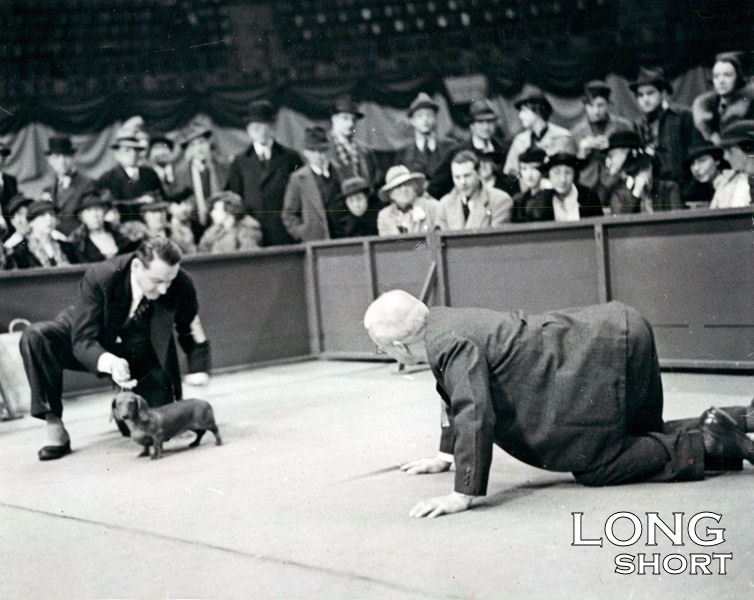
Great Westminster Dachshund History: Judging Dachshund

wirephoto1
Judging Dachshund by Samuel Falk - click it to enlarge

 
"Woof."  Judges rate this the best feature picture of 1937.  It won first prize in that division at the Press Photographers' association exhibit in New York.  It is a "spot" news picture of a judge in action at a Madison Square Garden dog show.  Its show title is "Judging Dachshund."  Source:  Chicago Daily Tribune; Jan 30, 1938.  Photo:  Joey and Maggie's personal collection.

The original text on the back of the photo read: 

CANDID CAMERA SIDELIGHTS OF WESTMINSTER DOG SHOW

NEW YORK CITY - On Feb 10, 11, and 12 thousands of dog lovers jammed into Madison Square Garden to witness the sixty-first annual exhibition of the Westminster Kennel Club.  The 3,144 dogs entered, representing 96 breeds from all parts of the world set a record.  The Wide World Service has already brought you general views of the show and its champions.  In this set of pictures, made by a staff photographer working with a candid camera, Wide World now brings you some of the scenes visitors saw in the judging ring and at the benches of the blue ribbon event of the canine world.

A dignified Englishman takes his judging seriously, getting down on his hands and knees to evaluate a Dachshund, one of the most popular breeds in the show.

February 13, 1937

Joey's Corner: Piebalds in History: The Dot Cartoonist

out cartoon2

The Dot Cartoonist
by GEORGE BELL

"Noah's ark must have been of great dimensions to be
long enough to admit the daschund and the ceilings
high enough to accommodate the ..................."
(Kindly draw straight lines between the numbers.)

as published in The Chicago Defender (National edition); March 13, 1937

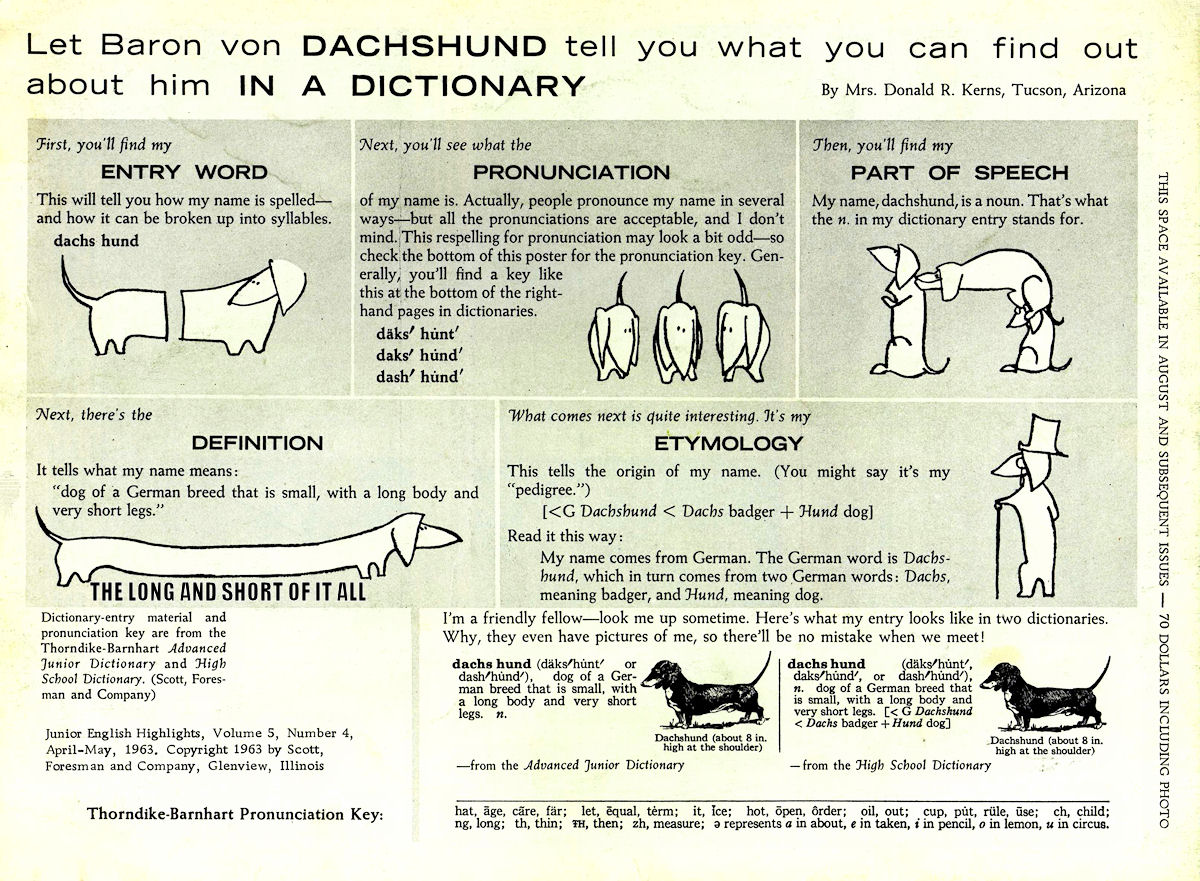
Vintage Dachshund Education: Let Baron von DACHSHUND tell you what you can find out about him IN A DICTIONARY

Dachshund Education
(click image to enlarge)

Let Baron von DACHSHUND tell you what you can find out about him IN A DICTIONARY by Mrs. Donald R. Kerns, Tucson, Arizona.

It's education day at The Long and Short of it All.  We've wanted to share this fantastic dictionary synopsis of the Dachshund for the longest time.  This was the back cover of the May, 1967 issue of the American Dachshund magazine.  Dachshund 101, indeed; wikipedia ain't got nothin' on this masterpiece.
 
Support : Creating Website | Johny Template | Mas Template
Copyright © 2011. News and daily Dogs - All Rights Reserved
Template Modify by Creating Website
Proudly powered by Blogger